
From Watson to Granite: Students Building Games with IBM AI
Since 2019, BSc Creative Computing students have taken part in an ongoing collaboration with IBM through the Creative Industry Challenge, led by Dr Coral Manton. Each year, students respond to live project briefs set and supervised by John McNamara, Master Inventor and UK University Program Lead at IBM, exploring how IBM’s AI and cloud technologies can be used to create innovative and meaningful games.
The partnership gives students hands-on experience with professional tools and workflows while working to real industry briefs. Across the years, projects have been showcased at multiple public events, including the Bristol VR Lab and Bath Digital Festival, highlighting the creative and technical ambition of student work.
Through this collaboration, students have experimented with a wide range of IBM technologies. Early projects explored sentiment analysis, personality insights and voice-assistant tools using IBM Watson. More recently, students have begun working with large language models through IBM Granite, opening up new possibilities for narrative design, player interaction and responsive game worlds.
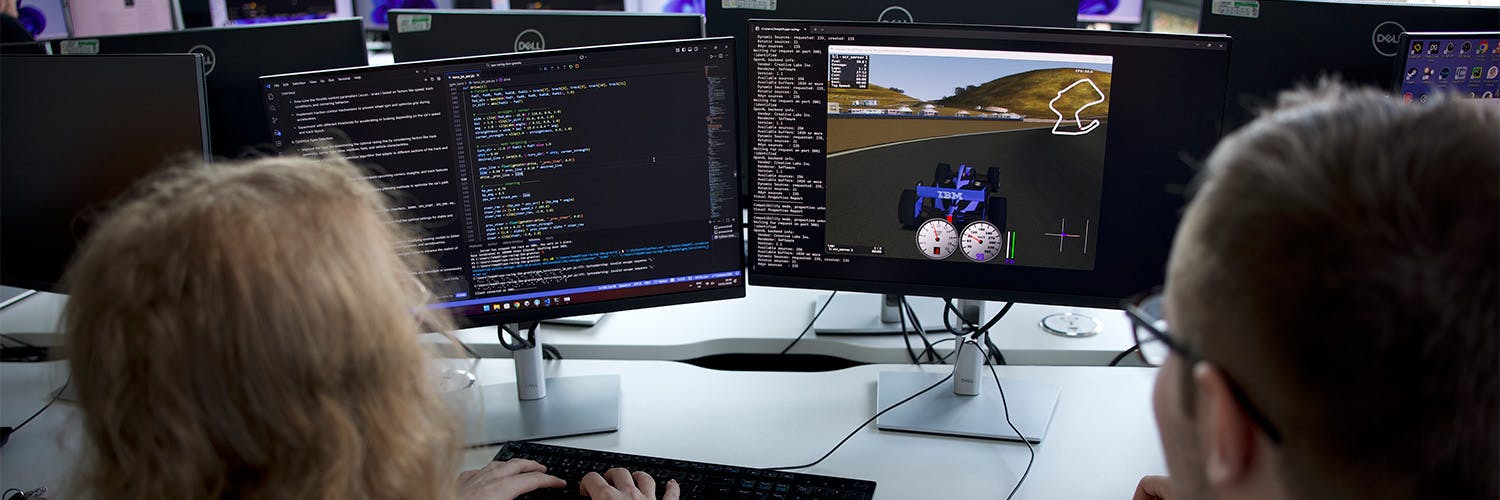
Most recently, IBM has invited us to become early adopters in their new AI Racing League initiative, designed to upskill students in cutting-edge AI tools, including Granite, and to explore how machine learning can support competitive gameplay, simulation and real-time decision-making.
Year 1: NiceBots! (2019)
In the first year of the collaboration, students were tasked with creating games using IBM Watson’s AI tools. The resulting project, NiceBots!, focused on mental health and positive online behaviour, asking a simple question: what if a game could encourage people to be kinder on social media?
The team designed a competitive multiplayer game, built for mobile, in which players build and battle small space-fighter robots. The twist is that progression is linked to a player’s online behaviour. Using IBM Watson Personality Insights, the game analyses a player’s Twitter feed and generates a personality profile. This profile is compared to an “ideal” personality chosen by the player at the start of the game, unlocking different weapons, shields and power-ups used to customise their robot.
Watson’s Personality Insights service uses language analysis to identify traits based on the ‘Big Five’ personality model: Agreeableness, Conscientiousness, Extraversion, Openness and Emotional Range. These are broken down into more detailed attributes — such as altruism, cooperation and trust — each measured on a scale from 0 to 1. Students used Node.js to retrieve and process this data, selecting the traits most closely associated with positive behaviour online and integrating them into gameplay mechanics.
As players improve their in-game performance and their personality scores, they unlock new modules to strengthen their robot. For example, higher agreeableness might unlock stronger shields, while other traits influence fire rate, movement or power-ups. By linking rewards both to gameplay success and positive online engagement, Nice Bots playfully encourages users to reflect on how they interact with others — and what it means to be a “good” person online.
During development, students also experimented with analysing the Twitter accounts of well-known public figures. This helped them explore where sentiment and personality analysis worked effectively and where it struggled to capture nuance, irony or context — prompting useful discussions about the ethics and limitations of AI-driven interpretation of online behaviour.
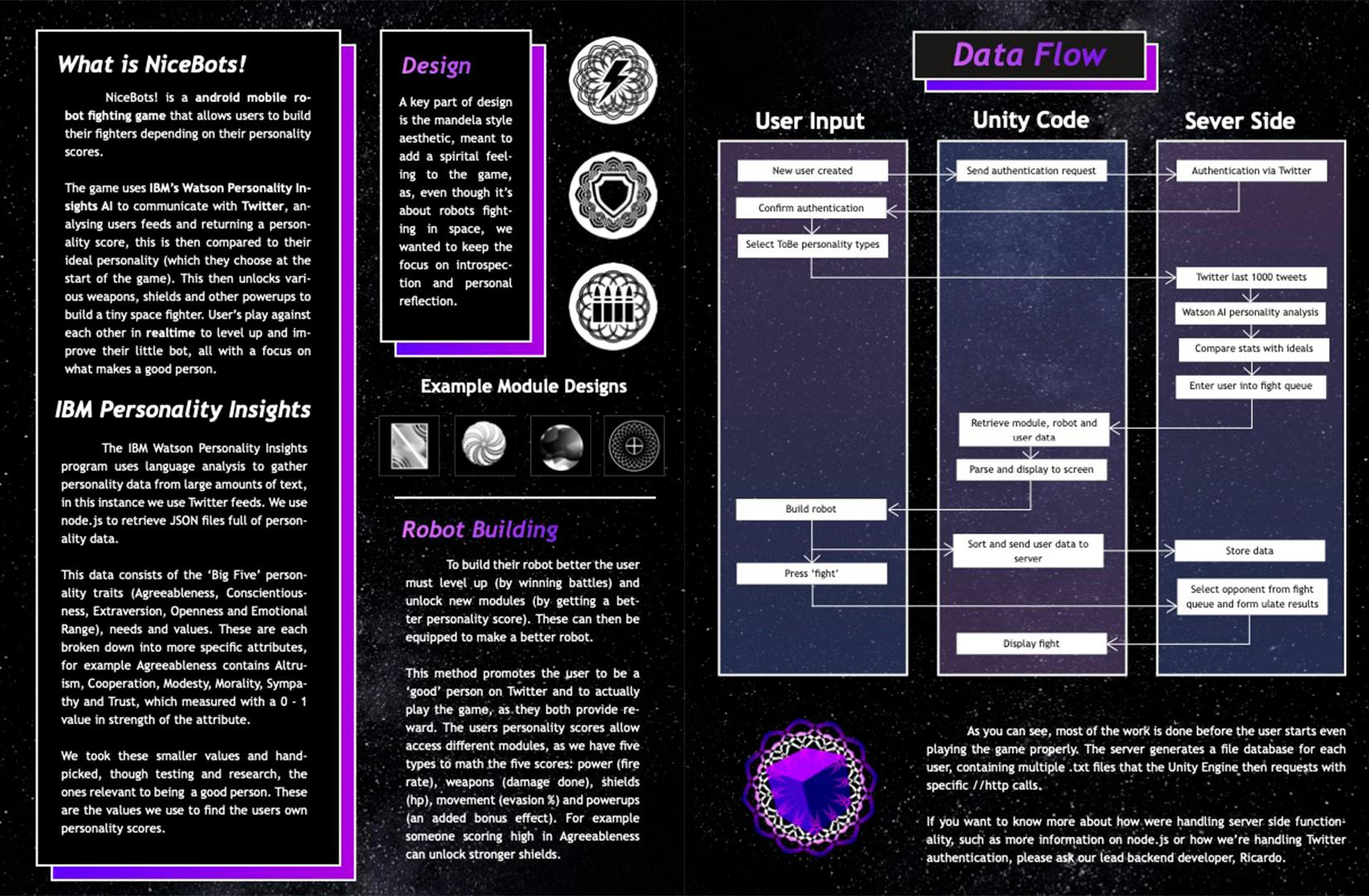
NiceBots! Team: Rose Baker, Ricardo Graca, Aaron Desoiza, Adam Hartnell Holmes
Voice and Behaviour Analysis Game (2019)
Alongside the first year of the IBM collaboration, we had students exploring how AI could be used to create responsive and personalised gameplay experiences. One project from 2019 was Voice and Behaviour Analysis Game, developed by BSc Creative Computing student Natalia Pietrzak.
The project investigated how player behaviour and emotional state could shape a game in real time. Using IBM Watson tools, the game gathers and analyses player data to generate a tailored level for each individual player. Behavioural data collected through gameplay is mapped against the ‘Big Five’ personality traits, allowing the system to build a profile of how a player approaches challenges, exploration and interaction.
The game also responds to voice input. By using IBM Watson Speech-to-Text and Tone Analyser, the system identifies emotional cues in the player’s speech and adjusts gameplay accordingly. Tailored quests, environmental changes and level dynamics are adapted in response to the player’s current mood, creating a more personalised and reactive experience. In-game data collection points continuously monitor how the player interacts with the world, enabling further adjustments to be made as the level unfolds.
Developed in the Unity game engine and integrated with IBM Watson services, the project demonstrated an early exploration of adaptive AI-driven gameplay within the collaboration. It also highlighted student interest in how voice, emotion and behavioural data might shape future interactive experiences, raising important questions about responsiveness, immersion and the ethical use of player data.
Year 2: Games for Resilience (2021)
In year two, students developed their projects during the national COVID-19 lockdowns. Responding directly to this context, they were asked to design prototype games that could help people connect and support wellbeing during periods of isolation and restricted social contact.
Working to a joint brief set by IBM and Bath Spa University, students explored how game design and IBM Cloud tools could encourage communication, emotional expression and mental health awareness during the pandemic. Two teams took distinct approaches to the challenge.
Friendship in Jeopardy was a multiplayer VR quiz-show game designed to bring friends together in a shared virtual space. Players competed to answer multiple-choice questions delivered by a quiz-show host powered by IBM Watson. Using Watson Assistant and Text-to-Speech, the AI host generated and delivered questions in real time. The concept was inspired by IBM Watson’s appearance on the American quiz show Jeopardy! as part of the DeepQA project, where it famously won in 2011. The game was developed in the Unity game engine using the Watson Unity SDK.
Friends in Jeopardy! Team: James Templeman, Caleb Percival Ben Sandison, Conor Farman and Kieran Owens
Pocket Druid took a more reflective approach, combining gardening, magic and social interaction to support emotional wellbeing. This multiplayer mobile game allowed players to cultivate a personal island garden while visiting the islands of others to socialise online. Progress within the game was linked to emotional expression: players spoke to druid familiars and plants, sharing thoughts and feelings in order to help their garden grow. As players expressed different emotions, new plants, abilities and environments were unlocked.
The game responded directly to the brief to support mental health during lockdown using IBM Cloud tools. It integrated Speech-to-Text and Sentiment Analysis to interpret players’ spoken reflections, with different sentiments unlocking new features and interactions. Like Friendship in Jeopardy, it was developed in Unity using the Watson Unity SDK.
Pocket Druid Team: Greg Sutton, Casper Witor, Archie Bower, Samuel Hancock and Dylan Tolley
Together, these projects explored how playful digital environments could support connection, communication and resilience during a period of social isolation, demonstrating the potential of creative technology and AI tools to foster social wellbeing in challenging circumstances.
Year 3: SkillsBuild (2023)
In the third year, students responded to a brief from IBM focused on supporting university students to develop skills in emerging technologies, including cloud computing and artificial intelligence. The project centred on the IBM Academic Initiative, a global, self-guided learning programme that provides students with access to IBM Cloud resources and accredited online courses in areas such as Watson AI, blockchain and data science.
Alongside promoting these learning opportunities, the brief asked students to showcase previous Bath Spa University Creative Computing projects that had used IBM tools, demonstrating how technologies such as Watson can be applied in creative and interdisciplinary contexts. The aim was both practical and inspirational: to help students navigate available training resources while highlighting real examples of creative experimentation with AI and cloud technologies.
Students were tasked with designing an interactive online space using Mozilla Hubs and Spoke that would act as a signposting environment for the IBM Academic Initiative. The virtual hub brought together information about learning pathways, tools and opportunities, alongside featured student projects from Bath Spa and beyond. The space was designed to be playful, accessible and engaging, reflecting the inventive spirit of the IBM Innovation Lab while encouraging exploration and self-directed learning.
Through this project, students developed skills in virtual environment design, user experience and digital storytelling, while also considering how online spaces can support peer learning and community building around emerging technologies. The resulting hubs functioned as both resource portals and creative showcases, helping to connect future computing students with tools, ideas and examples that could shape their own projects and career pathways.
IBM SkillBuild Hub Team: Luke Friskney, Ella Paddon, Leah Van-Zyl, Gage Knight
Year 4: IBM Granite (2026)
In the fourth year of the collaboration, students have been working with IBM SkillsBuild resources and IBM’s Granite models to design and develop a new space-based game, alongside a technical blog intended to share their learning with other students. The aim is not only to build a playable prototype but also to document the process of working with emerging AI tools, helping to demystify how large language models and cloud-based AI services can support creative game development.
Students are testing how effective different models, prompts and development approaches are when building game systems in Python. This includes experimenting with AI-assisted coding workflows, asset generation and gameplay logic, as well as evaluating where human design decisions remain essential. By reflecting on both successes and limitations, the project encourages students to think critically about how AI can support — rather than replace — creative technology practice.
The resulting projects and blogs will be shared publicly and showcased at Bath Digital Festival, continuing the partnership’s emphasis on real-world audiences and industry engagement. Through this process, students gain experience not only in building with AI tools but also in communicating their methods and findings to wider creative and technical communities.
AI Racing League Initiative
Alongside the Granite game project, we were invited by IBM to take part in testing their new AI Racing League initiative, designed to upskill students in cutting-edge AI tools and machine learning workflows.
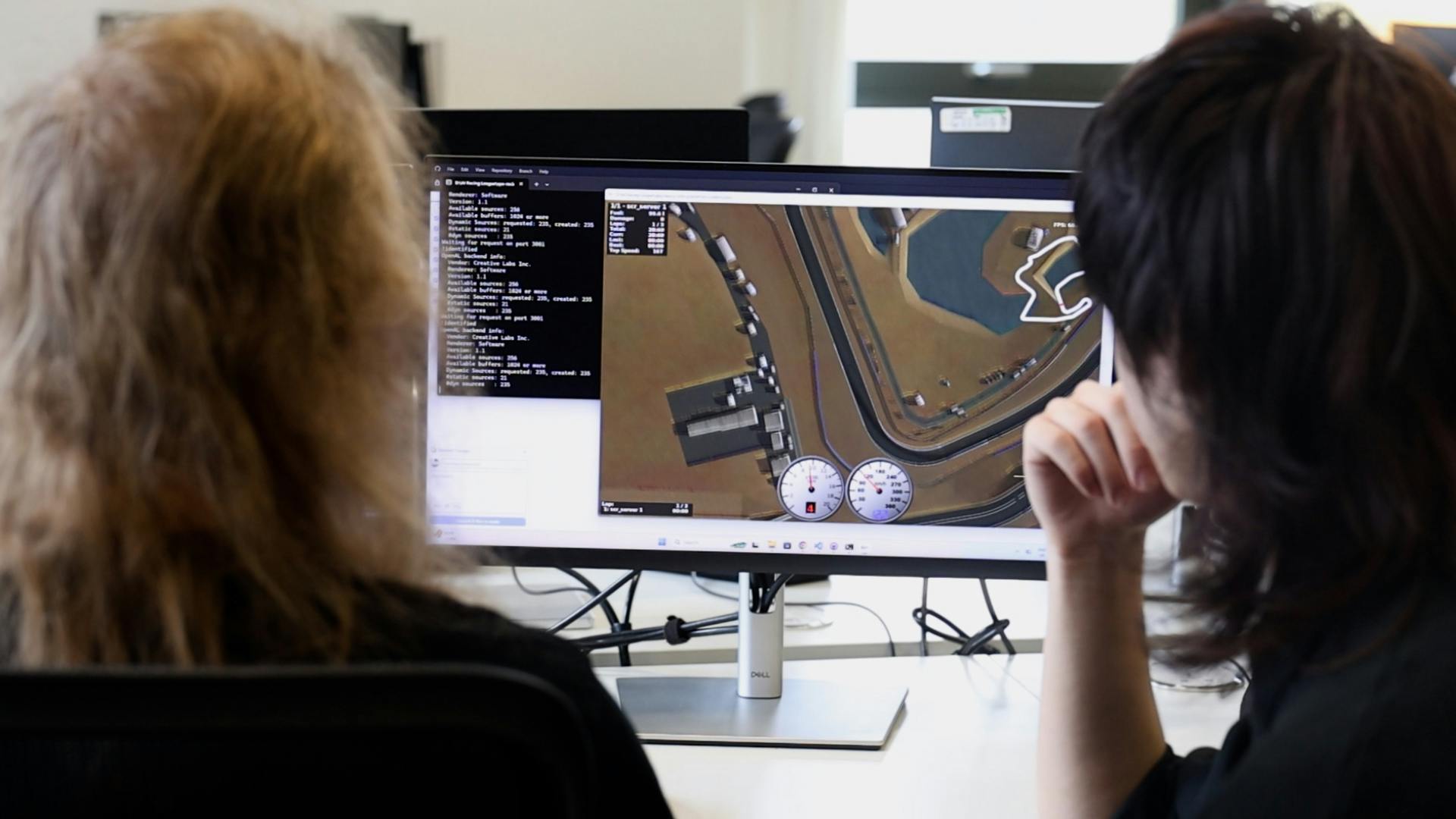
Students were challenged to train an AI-powered Formula One racing car and compete against university teams from across the UK to achieve the fastest single-lap time. To do this, they have been working through IBM’s SkillsBuild platform, learning how Granite models can be combined with reinforcement learning concepts to optimise performance. The challenge requires students to analyse telemetry data, refine decision-making models and continually iterate their approach to shave precious milliseconds off each lap.
The initiative introduces students to core ideas in simulation, optimisation and machine learning within a competitive and collaborative framework. It also provides valuable insight into how AI is used in real-world engineering and performance contexts, from autonomous systems to predictive modelling.
Taking part as early adopters has allowed our students to test emerging tools, develop new technical skills and contribute feedback to IBM on how these platforms can best support learning in creative computing and game development.
Together, these projects trace a clear journey from early experiments with Watson services to current work with Granite and machine learning, showing how the collaboration has evolved alongside the technologies themselves. Across six years, students have not only learned to use industry tools but have also critically explored how AI can shape play, storytelling and social interaction. The partnership continues to provide a space for experimentation, reflection and real-world engagement, ensuring that students graduate with both technical skills and a thoughtful understanding of how creative technologies can be used responsibly and imaginatively.