
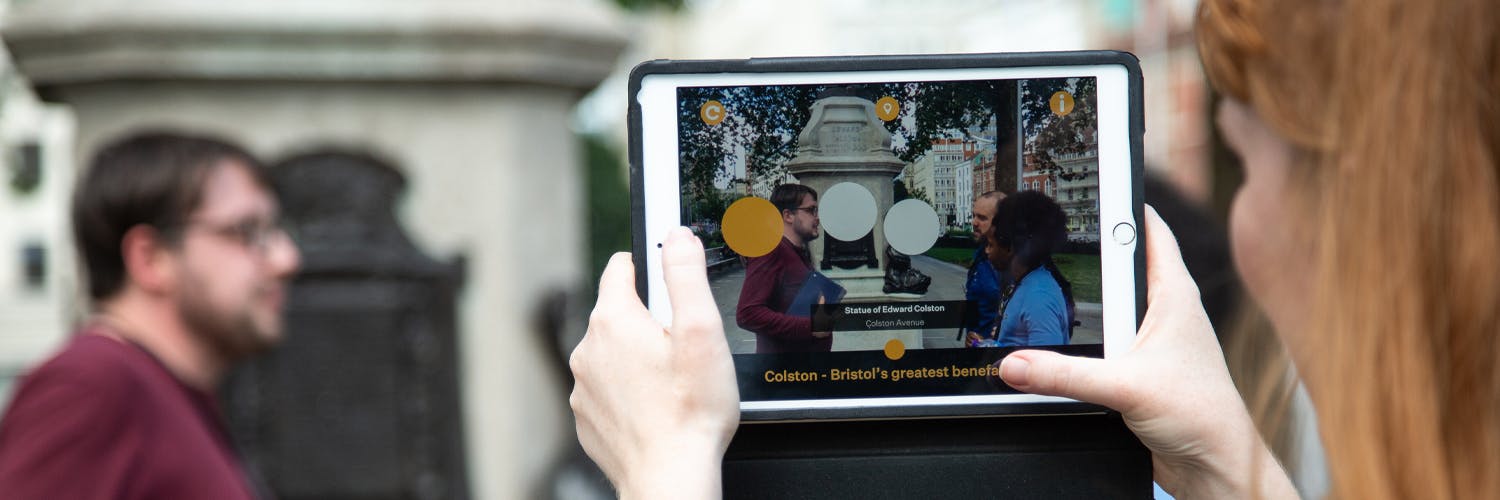
Shared Pasts: Decoding Complexity
The Shared Pasts: Decoding Complexity app prototype was developed through Dr Coral Manton’s Immersion Fellowship and a prototype fund from the South West Creative Technology Network (SWCTN). It was launched at a public event at Arnolfini and Watershed in Bristol, where it received very positive feedback from audiences and cultural sector partners.
The project builds on research by SWCTN Academic Fellow Coral Manton and explores how augmented reality (AR) can enable audiences to engage with complex, layered histories in new ways.
Why this project now
At this moment in UK history, there is a pressing need to engage more openly with contested pasts and to recognise how perspective shapes understanding. Cultural collections and heritage sites often hold multiple, sometimes conflicting narratives.
Shared Pasts: Decoding Complexity addresses the challenge of seeing from others’ viewpoints, recognising complexity, and moving beyond echo chambers. The platform is designed to challenge potential bias in how we encounter history by enabling audiences to explore alternative narratives through an intuitive interface and a recommendation system that actively broadens perspective.
Bristol, like many UK cities, contains histories deeply connected to colonialism, empire and the transatlantic slave trade. This project focuses on revealing the intricacy surrounding these histories, bringing forward the people, social structures and contexts connected to objects and places across the city.
Prototype showcase
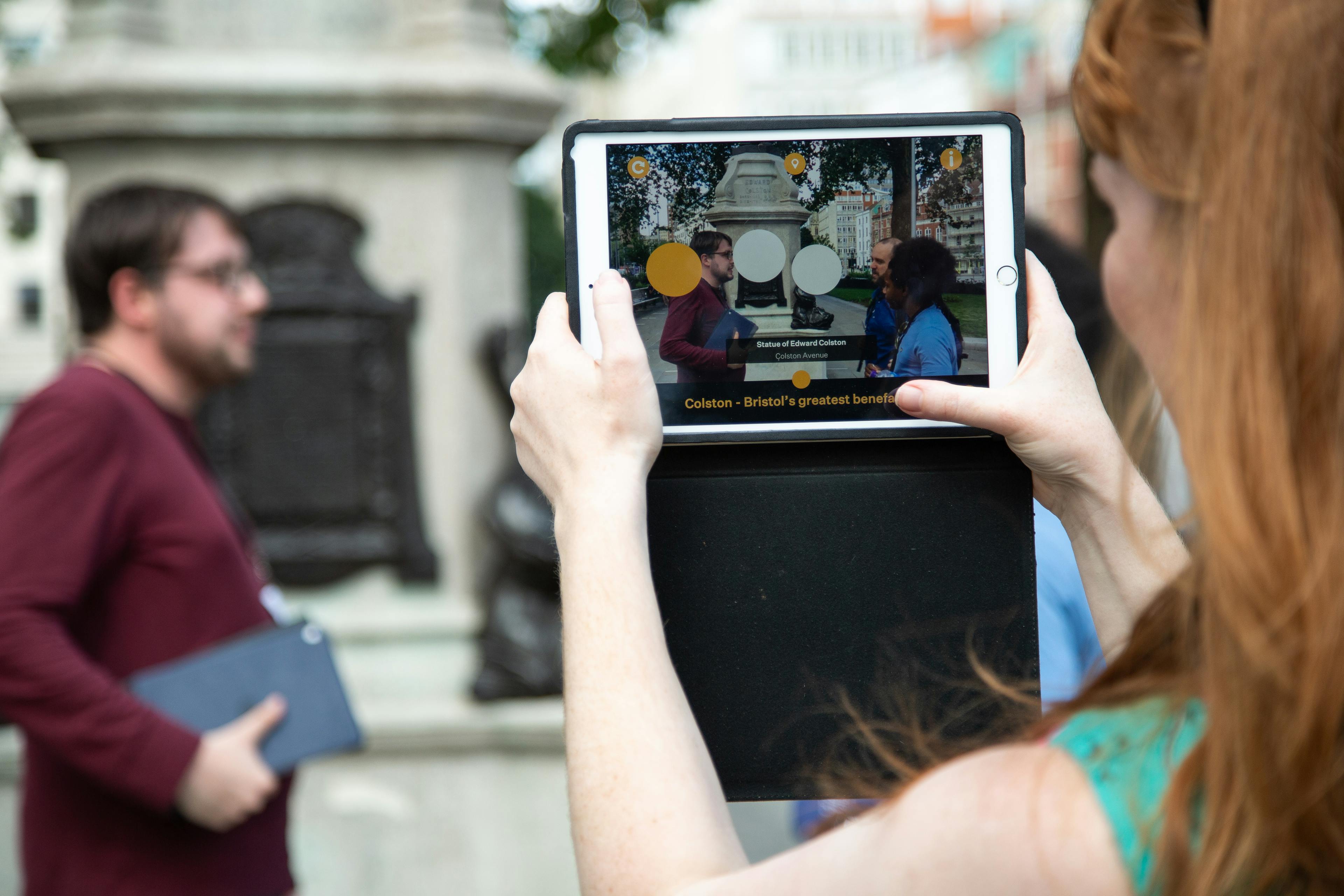
The prototype was presented publicly at the SWCTN event at Arnolfini and Watershed. Visitors explored how AR can reveal multiple narrative layers around historic artefacts and sites. Feedback highlighted strong interest in the platform’s potential for museums, galleries and heritage organisations seeking new ways to engage audiences with complex histories.
How the platform works

Shared Pasts: Decoding Complexity uses augmented reality to reveal layered narratives built on historic artefacts and places. Rather than presenting a single authoritative story, the platform offers a 360-degree view of the past, demonstrating how meaning-making depends on the lens through which history is viewed.
Key features include:
- Layered AR storytelling revealing multiple perspectives around objects and sites.
- Narrative recommendation system inspired by streaming platforms, but designed to counter bias by suggesting viewpoints different from a user’s own.
- Machine-learning backend that encourages exploration of opposing or under-represented perspectives rather than reinforcing personalisation.
- A new storytelling platform that enables and amplifies a broader range of voices in the retelling of history.
The initial prototype focuses on narratives of colonialism, empire and slavery in Bristol, opening space for dialogue around the city’s relationship to wealth, growth and the transatlantic slave trade.
Creative and research team
The project brought together a multidisciplinary team led by Dr Coral Manton — museum curator, creative technologist and Lecturer in Creative Computing at Bath Spa University.
She is working with Chris Hunt (Controlled Frenzy) to develop the application and platform.
Research and narrative development draw on expertise from:
- Sue Giles, Senior Curator of World Cultures, Bristol Museums
- Professor Olivette Otele, Professor of Slavery, University of Bristol
- Writer Lisa Harewood
- Interactive fiction researcher Julia Scott-Stevenson
Narration is provided by Bristol-born actor Adjoa Andoh, with voice direction by Sarah Addezio.
3D scanning and technical development involved partners including CAMERA at the University of Bath.
Sector context and innovation
Immersive technologies are increasingly used in the cultural sector to help audiences experience history. However, immersive storytelling can sometimes simplify complex narratives by focusing on a single viewpoint.
This project proposes a different approach: a platform that foregrounds complexity and multiplicity, allowing users to explore contested histories from many perspectives. By actively recommending alternative viewpoints, the system challenges the idea of passive personalisation and instead encourages critical engagement with the past.
Partners and next steps
The prototype has been developed with the support of:
- Bristol Museums
- The British Library
- Bath Spa University
- South West Creative Technology Network (SWCTN)
Following the successful showcase, the next phase will focus on:
- Securing funding to build the next stage of the platform
- Expanding narrative content and locations
- Testing with additional cultural venues
- Developing partnerships across the heritage sector
Our aim is to create a scalable platform that enables cultural organisations to present complex histories in more inclusive, nuanced and engaging ways.
We look forward to sharing updates as the project develops and to exploring collaborations with partners interested in the next phase.