
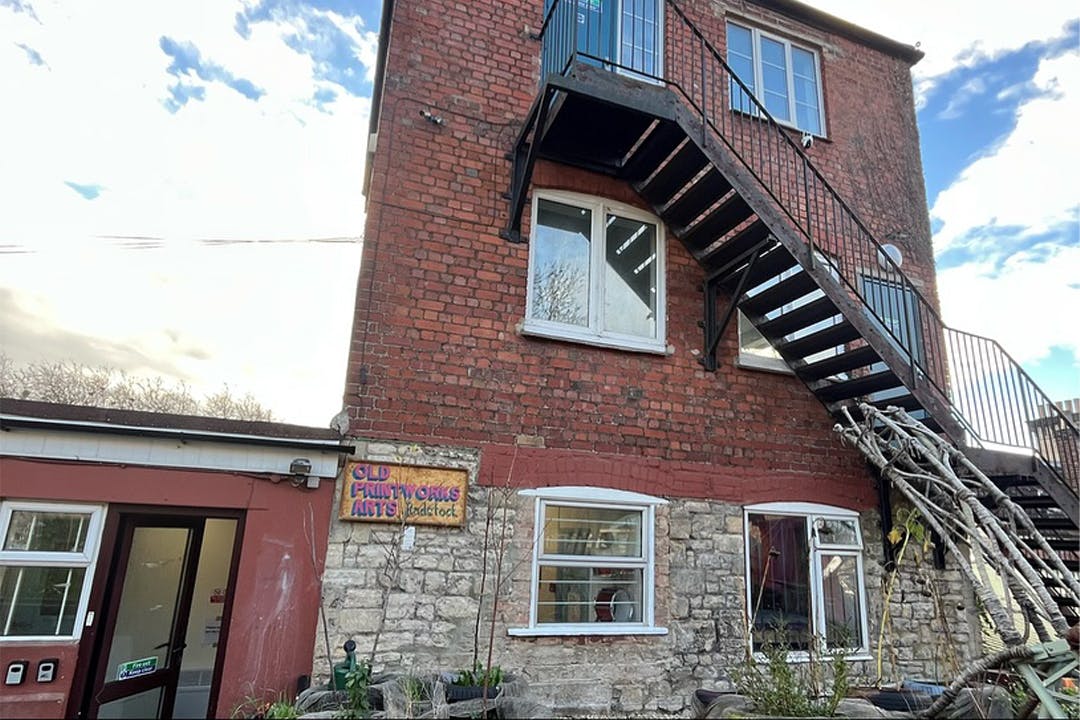
Old Printworks Arts is a community arts centre in Radstock established in 2023, serving a number of roles within the North East Somerset region. The centre is led by Ruby Sant's Little Lost Robot CIC with support from Bath Spa University's Inclusive Communities team and the Centre for Innovation and Knowledge Exchange, and the West of England Combined Authority. It provides residencies to local artists who face barriers to maintaining an arts practice, and also events, classes, and skills training in practical making for those out of work or reskilling for work.
As a long-time collaborator with artist, maker and community arts leader, Ruby Sant, I was invited to bring creative technology skills under a one-year residency.
The residency presented three main roles:
- Developing and running the inaugural offering for Robot Lab - a physical and digital making skills provision for interactive arts works;
- Working on funded creative technology projects with other residents on OPA, most notably Decoherence: a large scale tour-able art installation commissioned by CERN and installed at the Colours festival in Czechia in Summer 2026;
- Mentoring residents interested in developing their technology skills, and helping them realise their project goals.
Robot Lab
The goal for Robot Lab was to give learners employability skills with a grounding in physical fabrication skills in steel and welding (with talented engineer Tom Cherry), and in electronics, coding and control systems (with me) with an aim to make prototype physical creations that move, illuminate and react. Some of the learners are using this to enhance funding applications, or take first steps into new employment, immersive arts practice and events opportunities.
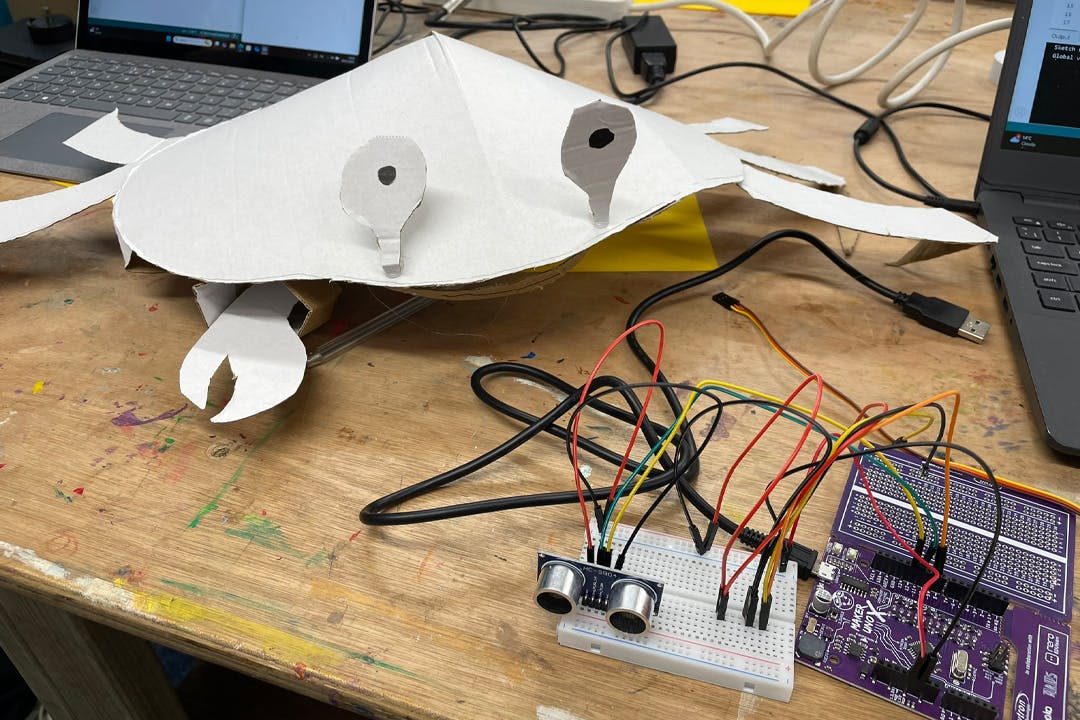
The challenge on the digital side is that many of the learners do not consider themselves to be technical, and may have had negative experiences with traditional forms of education. I led the sessions in an informal workshop style, with a focus on overcoming fear, and seeing results, with limited in-depth exploration of the technologies and techniques. In this way we could move through discovering the possibilities and limitations of Arduino's and their use in control, while considering how they might be useful in each individual's project goals. By the end of the first six weeks we had considered a number of ways we can sense movement and presence and use these with different types of motor to make art works move. Now into the second phase, I am working with the learners to get their creations ready for a showcase event in February 2026, where they are learning to flex their creative concepts in the light of practical constraints.
While the learners would probably not claim to have skills in Arduino's, electronics and coding that they could use fully independently, their confidence with concepts and making decisions about what could work, and how, is now strongly developed.
We are hoping to have several projects ready for the showcase:
- A static steel sculpture with weather-proof sequenced illuminated orbs that has already been exhibited at a light festival.
- A 'breathing', moving sculpture using airbags controlled by solenoids and sensors that will respond to visitors movements in a collaborative dance.
- A mechanical eyeball that blinks and whose gaze follows visitors as they move in front of it.
- A crab sculpture that waves at visitors when they move near it.
- Motion-responsive illuminated hankies for a side of Morris dancers.
Decoherence at Colours
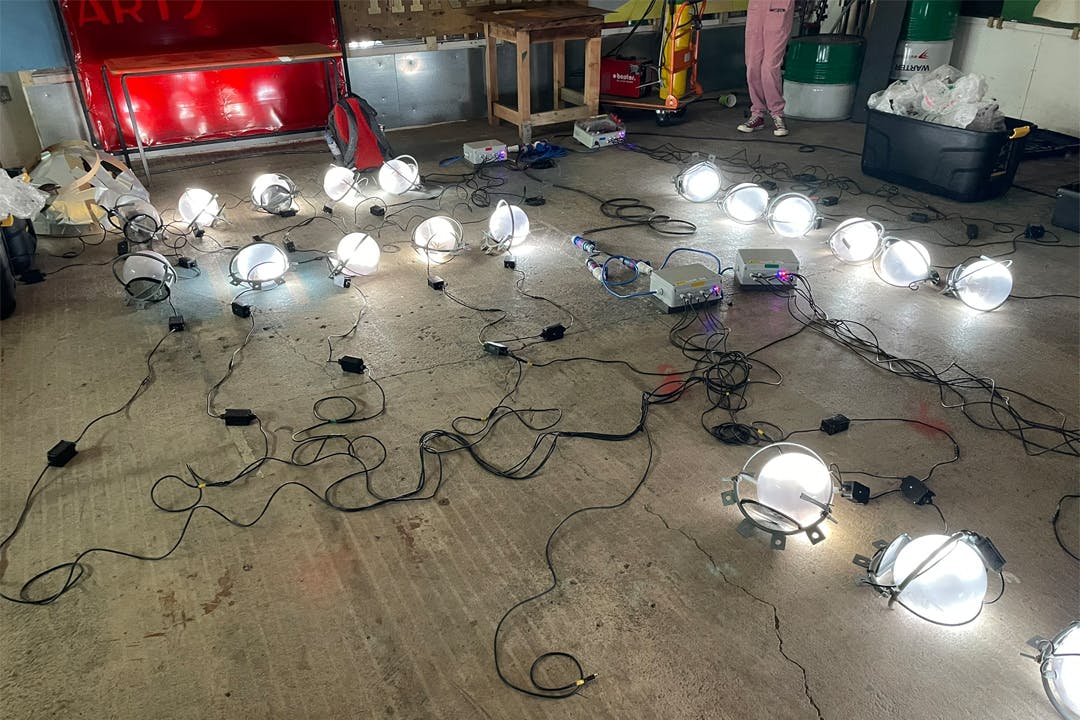
CERN approached Lost Robot to build a tourable sculpture that could communicate ideas around quantum decoherence alongside their science-communications events at several European cultural festivals. I worked with an experienced arts and steel fabrication team and several immersive arts interns on concepts, build and rigging for the eventual design. The concept we arrived at after group ideation was a number of illuminated orbs to represent the possible quantum state of particles held within a 6m arch representing the scale and form of a detector in the Large Hadron Collider at CERN. The twenty four custom-built orbs, each with 288 LED's and an ESP32 controller, are connected by WiFi and websockets to a central controlling node.js app. This assembly of tech triggers a visualisation of a decoherence event when 'observed' by a passing visitor.
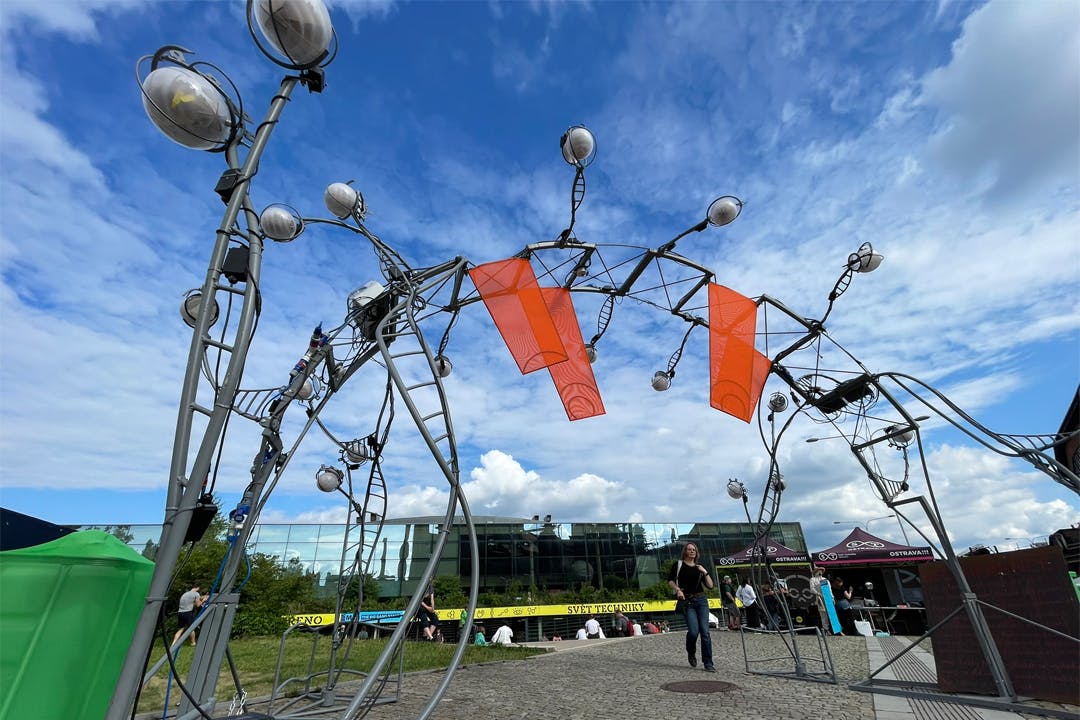
The selection of which technologies to use, how they relate to the creative and scientific vision, and how it could be built practically and robustly for an all-weather outdoor installation, developed over they first few weeks of development.
As a feasible technical design emerged we had to make sure power needs, safety, easy build and take-down and weatherproofing were all designed in. With a design nailed down, we had to work on scaling up - building 24 orbs (plus spares), and power supplies. My very capable creative technology intern, Robbie Linsdell, was able to ramp up production, with help from the other interns. We had a final test, with orbs attached to the sculpture a week before the festival opened, with just enough time for packing down and strapping on the trailer for its long road trip to the far side of Czechia.
I could not be onsite in Ostrava, Czechia for the build, which was a solid test of our processes and great experience for the interns on their first on-site build. There were, of course, problems, but by the time I was on site there were only minor changes needed. The ultrasound sensors were not triggering the 'observation' so we had to switch the system to a mixture of remote control and auto mode. CERN were very happy with the result, as were visitors, who had to pass under the arch to get to the Big Bang stage where the science talks and demos were held. the sculpture looked fantastic at night time.
People First
A community arts space acts as an important centre of gravity for people with all kinds of creative aspirations and skills, but also with needs, and barriers to getting on. OPA provides a nurturing space that address some of those barriers and needs, while providing a springboard for employability and life skills, creative confidence, and a community of support. While my particular skills lie in creative technology, it's the human values and experiences of this community that resonate and last. It's been a joy to be part of it.